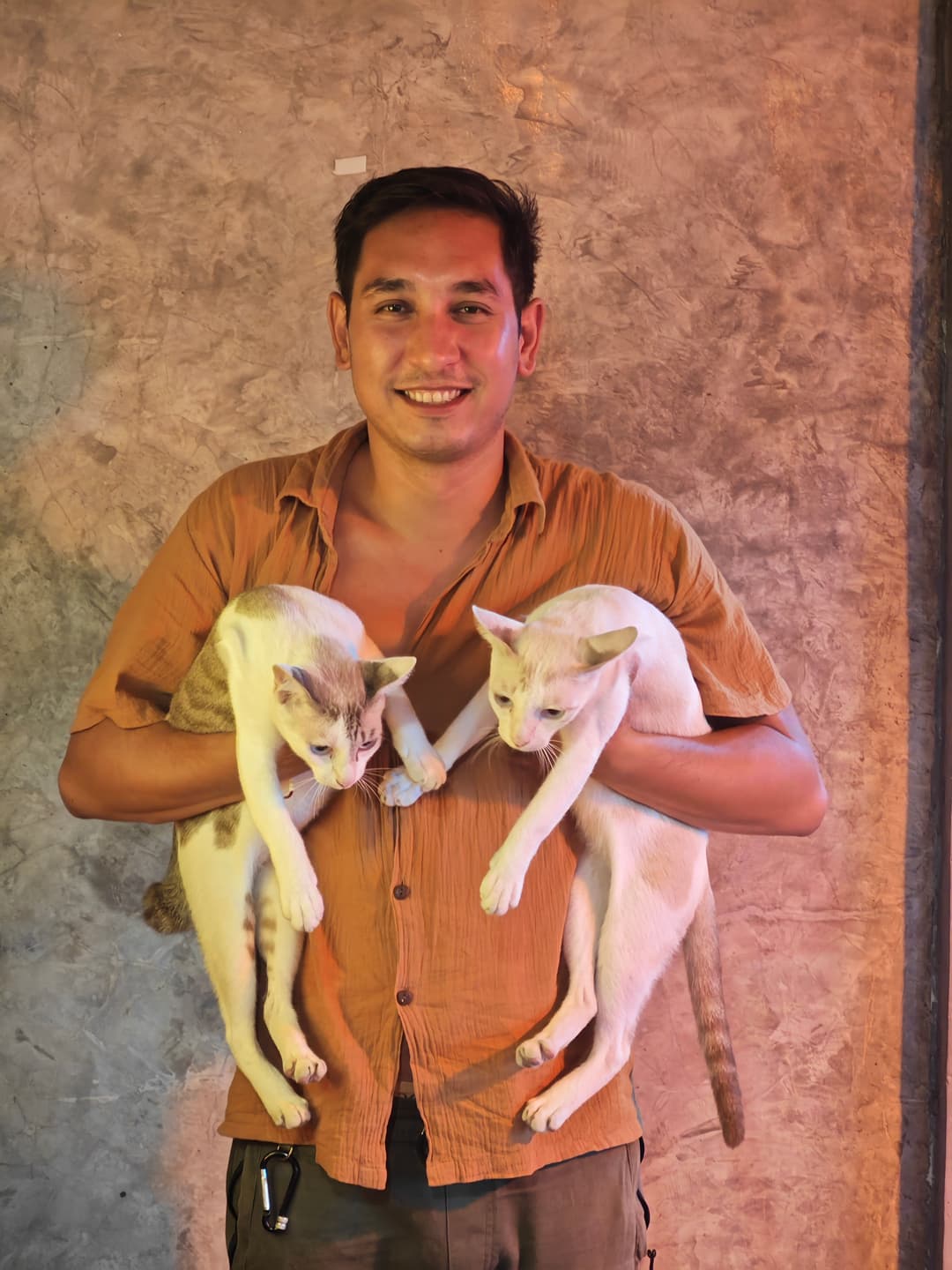
At one point my friend Andi had thirteen cats in his house. Not because he set out to — because every time he opened the door to his burger shop in Haad Rin, another one wandered in, and he could never bring himself to send any of them back out.
Before tourists
Andi was born on Koh Phangan and lived there until he was six. This was before tourists discovered the island, before full-moon parties had a Wikipedia page, back when Haad Rin was still mostly small houses, a few restaurants, and the sea. He saw the place when it was a place, not a destination. That memory is in him.
At six his family moved to the Italian-speaking part of Switzerland — that's where the name comes from. Andrea is an Italian name for a man. The English-speaking world tends to read it as a woman's name; the Italian world doesn't. We mostly call him Andi.
The burger shop
About five years ago, Andi went home. He'd been thinking about it for years and finally moved back to Koh Phangan to start a business of his own — a small burger shop in the middle of Haad Rin. The place is right where the old village used to be, near the beach, near the noise. The kind of location any sensible business owner would optimise for foot traffic and turnover.
When he took the keys, the building came with three little stray cats already living in it.
A different kind of business owner would have scared them off, or called someone to remove them, or built the kind of fence cats can't squeeze through. Andi fed them. He set up bowls. He named them.
The cat factory
You can guess what happens next. Cats talk to each other somehow — pheromones, body language, whatever it is — and word got around in the local stray community that there was a man on Haad Rin who would not say no. Another cat showed up. Then two more. Then a pregnant one, and then her kittens.
By the time I started counting, there were thirteen cats living in Andi's house. I started jokingly calling the place "the cat factory." The name stuck because it's accurate. A factory is a place that produces things on a schedule, and Andi's house was reliably producing cared-for cats — vaccinated, fed twice a day, spayed and neutered where possible, photographed in compromising sleeping positions on his laundry.
He never asked for help with this. He never set up a GoFundMe. He didn't post on Instagram about it. He just quietly did it, paid for it, and kept opening the door.
The factory has shrunk since. A virus moved through and a few of them didn't make it — Andi was the one taking them to the vet, sitting with them, paying for the medicine. He also placed four with families he trusted, which is the actual point of this kind of work and the bittersweet half of caring for animals you didn't plan on keeping forever. The remaining cats are healthier, calmer, and still his.
Where Animly came from
The thing about Andi is that there are a lot of him out there. People who didn't plan to become animal carers and ended up that way because they couldn't look away. The woman down the street with seven dogs. The retiree who feeds every cat in their neighbourhood. The shelter that started as one person renting a garage. The Andis of the world don't ask for help loudly. They keep saying yes until they can't afford to anymore, and then they cut something out of their own life to keep saying yes.
I built Animly because of him. The platform is for the official shelters too — the registered nonprofits, the rescue networks, the sanctuaries — but underneath all of that, the question I keep coming back to is: how do you help someone who would never ask?
You make it easy for the people who want to help to find them. You make sure the money actually arrives. You don't make Andi build a website, or learn accounting, or write a mission statement. You build the website for him.
The cat factory is still running, by the way. Smaller now, but the door is still open.